

Quick Answer
Yes, MECE (Mutually Exclusive, Collectively Exhaustive) can be genuinely useful for small businesses when applied to problem solving, customer segmentation, and decision making. It helps break down a messy problem into clear, non overlapping parts so nothing gets missed and nothing gets double counted. That said, it works best for complex or recurring decisions and can feel like overkill for very simple day to day choices. At stoninsider.com, we’ve found it most valuable when a business is trying to figure out where a real problem, like a drop in revenue, is actually coming from.
Introduction
If you’ve ever tried to figure out why your business isn’t hitting its numbers and ended up with a messy list of half related guesses, that’s usually a sign you need more structure, not more brainstorming. This is where the MECE framework comes in.
Originally developed at McKinsey and used heavily in management consulting, MECE stands for Mutually Exclusive, Collectively Exhaustive. This guide from stoninsider.com breaks down what that actually means in plain terms and whether it’s worth using if you run a small business rather than a corporate strategy team.
I’ve used this framework with small business owners trying to untangle profitability problems, and it consistently forces a clearer conversation than a loose brainstorm ever does.
What Does MECE Actually Mean?
This section explains the core idea behind MECE in plain language before getting into how small businesses can apply it.
MECE is really just two rules applied to how you group information or break down a problem.
Mutually Exclusive
Each category you create shouldn’t overlap with another. If a customer, cost, or issue could fit into two categories at once, the breakdown isn’t mutually exclusive.
Collectively Exhaustive
Every possible item needs a home somewhere in your categories. If something doesn’t fit anywhere, the breakdown has a gap, and gaps mean you might be missing the actual cause of a problem.
Is MECE Good for Small Businesses?
This heading answers the core question directly before going into specific use cases where it helps.
For most small businesses, MECE is worth learning as a thinking tool, even if you never use the term out loud with your team.
Where It Genuinely Helps
It works well when you’re trying to diagnose a business problem, like declining sales, rising costs, or customer churn, and want to avoid jumping to the first explanation that comes to mind.
Where It Can Feel Like Overkill
For quick, low stakes decisions, like picking between two suppliers with similar pricing, a full MECE breakdown probably isn’t necessary. It shines more in recurring or higher stakes decisions.
How Can a Small Business Use MECE in Practice?
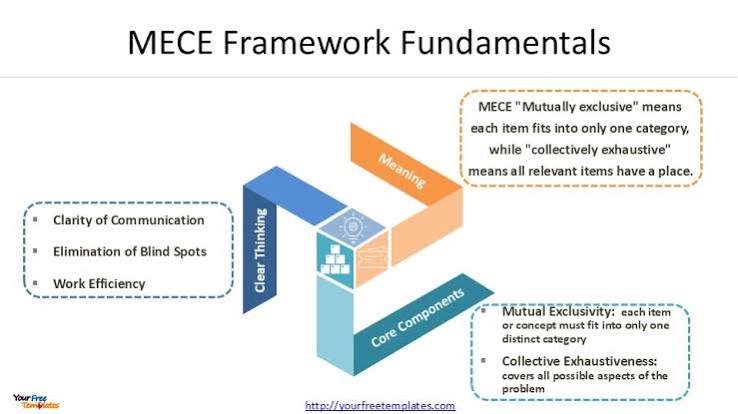
This is usually the part business owners care about most, since the theory only matters if it’s actually usable day to day.
The most common way small businesses apply MECE is through something called an issue tree, which breaks a big problem into smaller, non overlapping pieces.
Step 1: Write the Problem Clearly
Start with a specific problem statement, such as “revenue dropped 15% last quarter,” rather than something vague like “business is slow.”
Step 2: Break It Into Mutually Exclusive Branches
For a revenue drop, this might split into two clear branches: fewer customers, or lower spending per customer. These don’t overlap.
Step 3: Keep Breaking Down Until It’s Actionable
Under “fewer customers,” you might split further into new customer acquisition and existing customer retention. Keep going until each branch points to something you can actually investigate or fix.
Step 4: Test Each Branch Before Acting
Before committing budget or time, check the data behind each branch. In my experience, at least one branch that looked obvious on paper turned out to be a smaller factor than expected once we checked the actual numbers.
Common Small Business Use Cases for MECE
Some situations come up often enough that it’s worth knowing exactly where MECE tends to add the most value.
- Diagnosing a drop in revenue or profit
- Segmenting customers for marketing without overlap, such as by purchase frequency or acquisition channel
- Structuring a business plan or pitch deck into clear, distinct sections
- Reviewing costs by category (fixed vs variable, or by department) to find where to cut
- Organizing a decision with multiple options that need to be compared fairly
MECE vs Loose Brainstorming
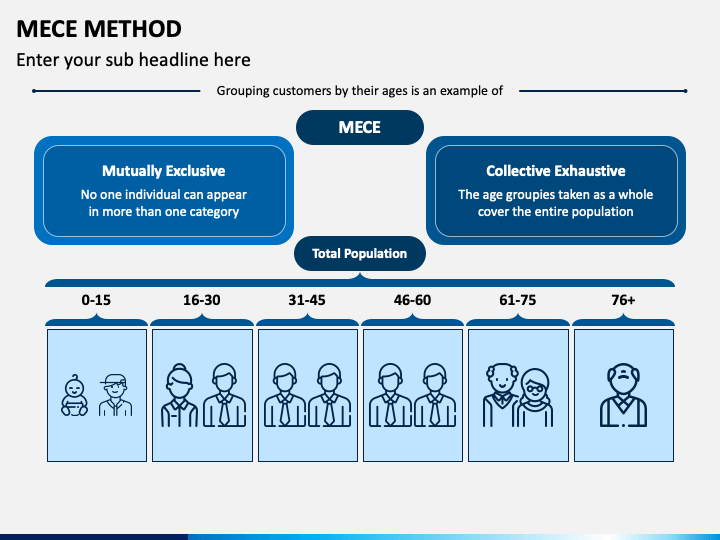
This comparison is useful for business owners deciding whether structured frameworks are worth the extra time compared to a quick team brainstorm.
| Approach | Best For | Risk |
|---|---|---|
| MECE Framework | Complex, recurring, or high stakes decisions | Can feel slow for small decisions |
| Loose Brainstorming | Quick, low stakes choices | Higher risk of overlap and missed factors |
| Hybrid Approach | Most day to day business planning | Requires knowing when to apply structure |
Pro Tip: In my experience helping business owners test their own breakdowns, the fastest way to catch a non MECE list is to ask “could this item fit in two categories at once?” If the answer is yes, the categories need adjusting before you trust the analysis.
Common Mistakes When Applying MECE
Even with good intentions, small business owners sometimes apply MECE loosely, which defeats the purpose of using it in the first place.
- Mixing different types of categories on the same level, like grouping “small businesses” with “online customers,” which can overlap
- Forcing MECE onto every small decision instead of the ones that actually need structured analysis
- Stopping the breakdown too early, before it becomes something you can act on
- Assuming a category list is exhaustive without double checking against real data
Frequently Asked Questions
What does MECE stand for?
MECE stands for Mutually Exclusive, Collectively Exhaustive, a framework originally developed at McKinsey for structuring business problems.
Is MECE only for large corporations and consultants?
No, while it originated in management consulting, the core idea works just as well for small business problem solving and planning.
Do I need special software to use MECE?
Not necessarily. Many small business owners use a simple issue tree diagram in a notebook, whiteboard, or basic tool like Google Slides or Miro.
How is MECE different from a regular pros and cons list?
A pros and cons list doesn’t require categories to avoid overlap or cover everything, while MECE specifically forces both of those conditions.
Can MECE help with marketing decisions?
Yes, it’s commonly used for customer segmentation, making sure your target groups don’t overlap and that no potential customer type is left out.
Is MECE the same as an issue tree?
An issue tree is one common way to apply MECE thinking visually, but MECE itself is the underlying principle behind the structure.
How long does it take to learn MECE?
The core concept can be understood in a single sitting, though applying it well to real business problems takes some practice.
Conclusion
There is no single number that defines a small business everywhere. It depends heavily on your industry, whether your sector is measured by revenue or employees, and which agency’s definition you are actually working with. If you are unsure where your business stands, checking your specific NAICS code against the SBA’s table is the most reliable starting point. At stoninsider.com, we try to make these kinds of confusing classification questions easier to navigate, one guide at a time.
- Is MECE Good for Small Businesses?
- Small Business Lawyer Near Me: Complete Guide
- Oakleigh Small Business Accountant: Complete Guide